
When a business owner first considers outsourcing, the question is almost always the same: “Should I hire someone local I can sit next to, or work with a Filipino virtual assistant remotely?” It is a fair question — and the honest answer depends on more than just the hourly rate. Below is a real, side-by-side comparison of cost and quality, so you can make the call with clear eyes instead of guesswork.
The true cost of a local hire
In the US, UK, Australia or Canada, the sticker wage is only the beginning. A local employee earning $25 an hour rarely costs you $25 an hour. Once you add the full picture, the real number climbs fast:
- Payroll taxes, superannuation or social-security contributions
- Health insurance and other mandated benefits
- Paid holidays, sick leave and vacation time
- Office space, a desk, equipment and software seats
- Recruitment fees and the weeks of lost productivity while you hire
Industry estimates put the true cost of an employee at 1.25 to 1.4 times their base salary. So that $25/hour hire is really costing you closer to $31–$35 an hour — before anyone has done a single task.
What a Filipino virtual assistant actually costs
A certified Filipino VA typically works for $8 to $15 an hour, depending on skill and experience. And because they are independent contractors working remotely, that rate is genuinely all-in. There is no office to rent, no equipment to buy, no payroll tax, no benefits to administer. You pay for the hours worked, and that is it. For specialised roles — SEO, WordPress, paid ads, automation — you still stay well under what a local junior would cost you fully loaded.
Cost comparison at a glance
Imagine you need 40 hours a week of support for a year. Here is roughly how the two paths compare:
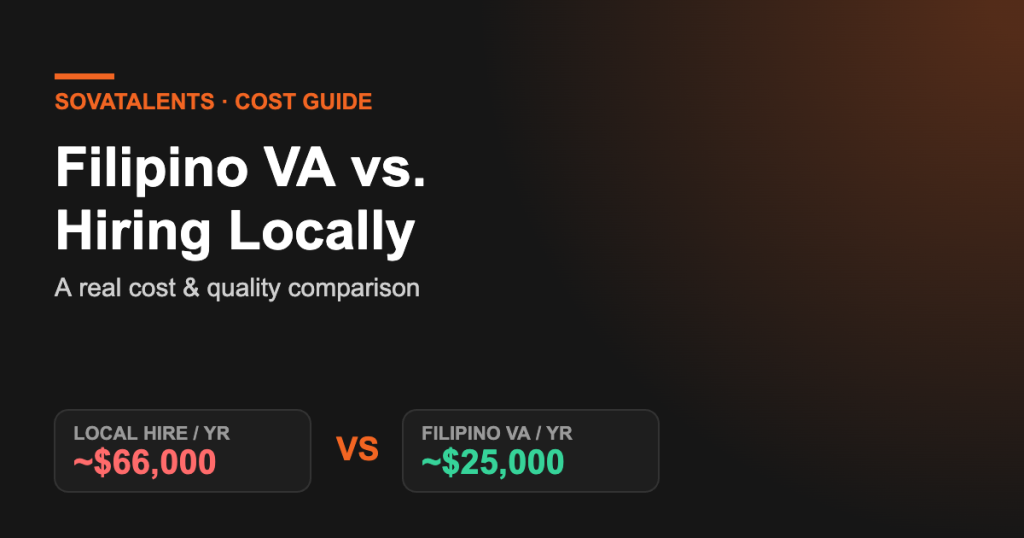
- Local hire at $25/hour, loaded to ~$32/hour → about $66,000 a year, plus recruitment and overhead.
- Filipino VA at $12/hour → about $25,000 a year, all-in, with no overhead.
That is a difference of roughly $40,000 a year for the same number of hours — money you can reinvest in growth, ads, or simply keep as margin.
But is the quality the same?
This is the real worry, and it deserves a straight answer: cheaper does not have to mean lower quality — but it can, if you hire blindly from an open marketplace. The Philippines has one of the largest English-speaking remote workforces in the world, a strong cultural alignment with Western business, and a deep talent pool trained specifically for online work. The difference between a great experience and a frustrating one comes down to vetting. A random freelancer bidding the lowest price is a gamble. A graduate who has completed a structured course and passed real, hands-on tasks is a known quantity.
Where a local hire still wins
To be fair, remote is not always the answer. A local employee makes more sense when the role requires physical presence, in-person client meetings, walking a sales floor, or handling tasks that genuinely cannot be done over the internet. There is also a real-time-collaboration advantage when someone shares your exact hours and sits in the same room. For most digital and administrative work, though, those advantages shrink quickly — and tools like Slack, Loom and shared dashboards close most of the gap.
The hidden advantages of a Filipino VA
Cost aside, there are upsides that rarely make it onto the spreadsheet:
- Time-zone coverage: work that gets done overnight and is ready when you wake up.
- Scalability: add a second or third VA in weeks, not months, with no office expansion.
- Specialisation on demand: hire an SEO specialist, a WordPress designer and a general VA separately, instead of forcing one local generalist to do it all.
- Loyalty: Filipino professionals are known for strong work ethic and long-term commitment when treated well.
How to get the best of both
The smartest businesses do not choose one or the other — they build a blended team. Keep the roles that truly need to be local, and delegate everything else to vetted remote talent. The key is to start with people who have been trained and certified, not strangers from a bidding war. That is exactly what SOVATalents exists for: every person in our directory is a graduate of PinoySEO or SOVA who completed real training and passed hands-on tasks. We hand-pick who appears here — there are no open sign-ups — so the quality question is answered before you ever start a conversation.
Ready to compare for yourself?
The numbers speak for themselves, but the right hire is what makes the difference. Browse our directory of certified Filipino SEO specialists, WordPress designers and virtual assistants, tell us what you need, and we will personally introduce you to the best-fit talent — free to browse, with a simple one-time placement fee only when you hire. See how far your budget can really go.